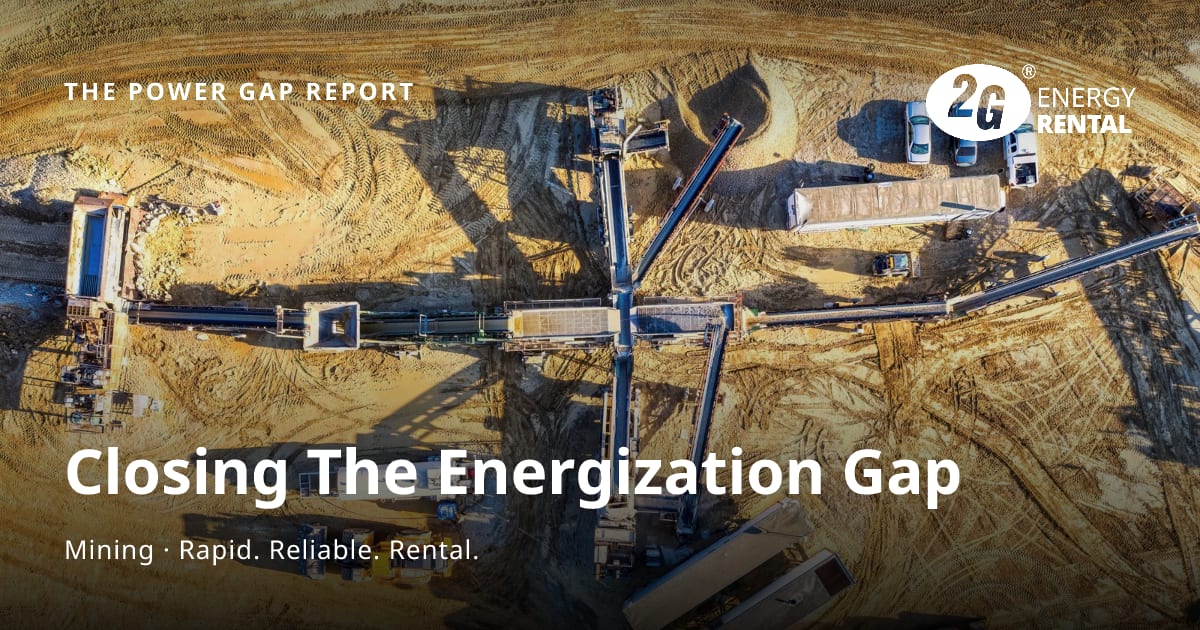
The mine is built, the processing equipment is on-site, but the lights won't turn on for a decade. This is the ready-to-run paradox facing modern industrial developers. Physical construction and equipment procurement move at a 24-month pace, while utility interconnection schedules have decoupled from reality, often stretching beyond ten years.
That window of forced dormancy is the energization gap — the multi-year void between site completion and the arrival of a permanent substation. In the speed-to-power paradigm, energy can no longer be a back-end procurement task. Forfeiting years of production to a utility queue is a strategic failure; treating power as a deployable asset is the only way to navigate the bottlenecks threatening the resource sector.
Quantifying The Wait
Relying on a utility to meet a go-live date subjects a project to a national queue of roughly 2,600 GW — more than double the entire installed generating capacity of the United States. In major hubs, firm-power wait times average five years and reach fourteen.
Historically, only 13% to 19% of the projects in the interconnection queue ever reach commercial operation.
| Equipment type | Lead time / availability | Deployment readiness |
|---|---|---|
| Large-frame gas turbines | 5–7 years (sold out through 2030) | Years of engineering & construction |
| Modular reciprocating units | Available now (weeks) | Commissioned and operational in weeks |
| Aeroderivative turbines | 18–36 months | Significant site prep required |
Under Batch Zero and reliability mandates like NOGRR282, the era of cost socialization is over — developers now fully fund the electrical infrastructure their sites require.
The Economics Of The Idle Month
Every month a mine sits idle waiting for the grid is a month of zero ROI on a massive investment. Industrial sites generate $10 million to $12 million per MW in annual revenue, so for a 20 MW operation a two-year delay approaches a quarter-billion dollars in lost income — compounded by stranded capacity, equipment prices that have tripled since 2019, and EPC costs that jumped from $2,000/kW to $3,000/kW in six months. Securing early revenue through on-site generation is the only way to recoup these investments in a high-inflation environment.
Reciprocating Engines Vs. Aeroderivative Turbines
Thermal performance is non-negotiable for remote sites, where site-derate variables — altitude, temperature, fuel — can collapse a power plan that looked fine on a spec sheet. While turbines can lose up to 27% of rated capacity in a heatwave, the Aura 412 R holds 100% output up to 45°C (113°F). Size for reality with N+1: a 6 MW site typically takes 15–16 units once adjusted to a real-world anchor like 340 kW at 33°C and 1,300 m on propane.
The Aura 412 R / 408 R platform delivers leading electrical efficiency in class, EPA-certified rich-burn technology with onboard 3-way catalysts, and I.R.I.S. predictive maintenance with remote telemetry for unstaffed, isolated sites.
Bridge Power Bypasses The Queue
Bridge power is the use of behind-the-meter generation to decouple a project's go-live date from the utility's schedule. The primary application is bridge-to-BTM: many operators have already purchased permanent equipment, only to see OEM delivery slip 24 months. 2G Energy Rental bridges the gap to the customer's own delayed gear — a temporary solution for a decision already made.
- Granular scaling — 500 kW blocks match a phased equipment rollout, avoiding all-or-nothing commitments
- Fuel flexibility — propane and wellhead gas bypass pipeline delays; trucking propane can energize a site in weeks while others wait years for a pipe
- Operational speed — plug-and-play modular units skip the multi-year engineering cycles turbines demand
The Post-Diesel Era
Diesel is familiar but legally barred from long-term bridge use — RICE rules restrict it to emergency-only operation. Natural gas and propane units are designed for prime (continuous) power, satisfy the air permits diesel can't, and eliminate the SPCC burden and logistics tail of large diesel fuel farms. That's the Rapid. Reliable. Rental. approach to high-regulation markets like the Permian Basin.
Remote loads energize late — but they don't have to. By decoupling the go-live date from both the utility's schedule and the OEM's backlog, a mine can turn a 14-year grid wait into a revenue-generating operation within months. For edge-of-grid developers, bridge power isn't a luxury; it's how high-value assets produce returns the moment they're ready to run.