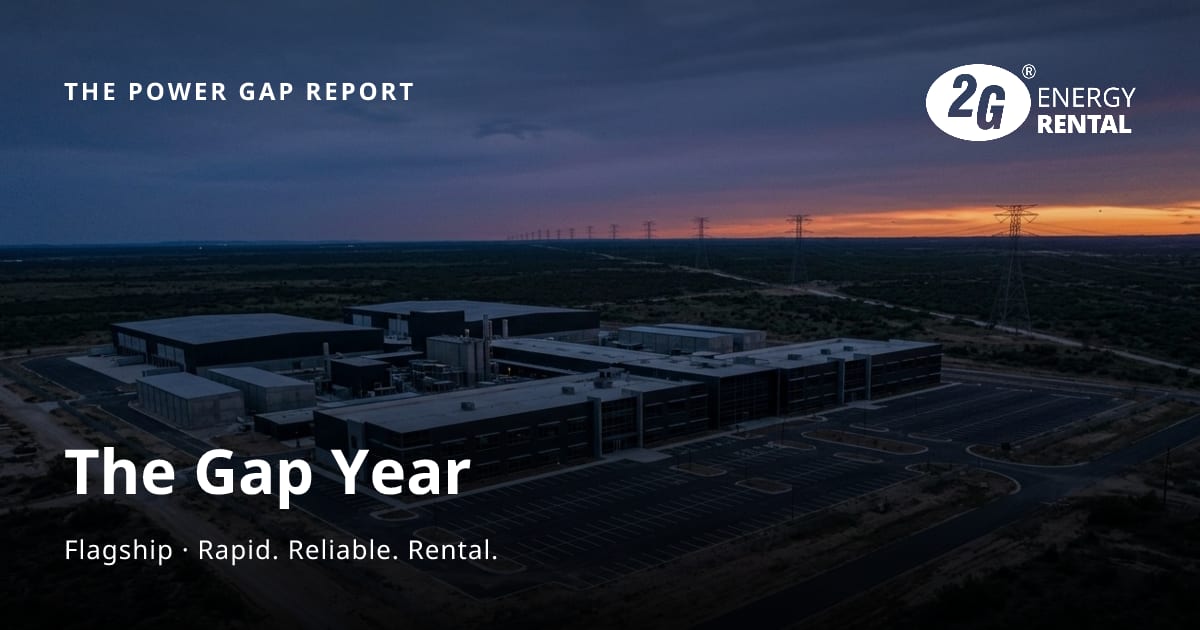
There is a year that doesn't show up on any pro forma. The building is finished, the equipment is on the pad, the capital is spent — and nothing turns on. For 12 to 36 months the asset sits complete and dark, waiting on a grid connection that hasn't arrived and permanent generation that hasn't shipped. That interval has become the single most expensive line item in industrial development, and almost no one budgets for it. This is the gap year.
It is not a data center problem, or an oil-and-gas problem, or a construction problem. It is the same structural gap appearing in every vertical that needs firm power — the space between when a project is ready to run and when the grid can actually carry it. The five reports in this series each trace that gap through a single load. This one is about the gap itself: why it opened, what a year of it costs, and the one discipline that closes it.
The Anatomy Of The Gap
The gap is the product of two failures compounding at once. The first is the interconnection queue. Securing firm utility power now takes 5 to 14 years — Northern Virginia has reached fourteen — and the national queue holds roughly 2,600 GW of requests, more than double the entire installed generating capacity of the United States. In Texas, the ERCOT large-load queue alone holds 438 GW, five times the state's historical peak. Getting in line is not the same as getting power: historically only 13% to 19% of queued projects ever reach commercial operation.
The second failure is the equipment supply chain that the grid itself depends on. Even a project that clears the queue meets a backlog measured in years for the hardware that connects it.
| Critical-path equipment | Lead time / availability |
|---|---|
| Large-power transformers | 160+ weeks |
| Generator step-up (GSU) units | ~144 weeks |
| Medium-voltage switchgear | Sold through 2028 |
| Large-frame gas turbines | 5–7 years (sold out through 2030) |
| Reciprocating gensets (Cat 3600 family) | ~107 weeks |
| Permanent behind-the-meter equipment | ~24-month OEM slippage |
Stack a multi-year queue on top of a multi-year equipment backlog and the arithmetic is unforgiving: a site that builds in 12 to 24 months routinely waits far longer than that for the power to use it. Equipment prices have tripled since 2019, and EPC costs jumped from $2,000/kW to $3,000/kW in a single six-month window — so the wait keeps getting more expensive even as it gets longer.
Every Vertical Meets The Same Wall
What makes the gap year a structural phenomenon rather than a sector story is that it doesn't discriminate by load. The wall is identical; only the asset waiting behind it changes.
- Data centers finish construction in 12 to 24 months, then sit dark for 12 to 36 while a transformer or a utility slot catches up. At $10 million to $12 million per MW in annual revenue, that delay is more than $20 million in lost income per megawatt.
- Fixed field infrastructure — compression, saltwater disposal, midstream electrification — is committed to and installed, then stranded because the grid can't accommodate it and the permanent gensets haven't landed. The test is simple: does the load move? If it doesn't, it's waiting.
- Construction feels the gap as schedule risk. When permanent power slips 18 months, trades sit idle against unabsorbed overhead and the general contractor carries liquidated-damages exposure the whole way.
- Mining and remote industrial sites hit the harshest version — a finished operation that can't energize for a decade, forfeiting production month after month on a national queue that clears fewer than one project in five.
- Commercial and industrial expansions land in the same interconnection line, paying for stranded capacity while an all-or-nothing turbine order they can't yet use inches through a five-to-seven-year backlog.
Five loads, one wall. The gap doesn't care what's behind it.
The Price Of A Year Spent Waiting
The reason the gap year is the most expensive line item nobody budgets for is that it charges twice. It charges once in lost revenue — an AI-class facility generates $10 million to $12 million per MW in annual income, so a two-year delay on even a 10 MW expansion is over $200 million that simply never gets earned. And it charges again in stranded capital: money committed to a completed asset that produces nothing, in an environment where the cost to build has already tripled.
A finished asset that cannot run is not an asset yet. It is a liability with a completion date — and every month in the gap is a month of return that will never be recovered.
That is the calculation that has quietly reordered how the most sophisticated developers think about power. Energization speed, not power cost, is now the variable that decides whether a project's economics work at all.
Bridge Power Closes The Gap
The gap year is not a force of nature. It is dead time — and dead time can be bridged. Bridge power is behind-the-meter generation that carries the load from the moment a site is ready until permanent power arrives, decoupling the go-live date from both the utility queue and the OEM backlog.
The primary play is bridge-to-BTM, and it is a gap-filler for a decision already made. In most cases the developer has already purchased permanent generation; the OEM delivery has simply slipped by roughly 24 months. Modular units bridge the specific gap to that delayed equipment — protecting the existing energy strategy rather than competing with it. Bridge-to-grid is the secondary play: temporary on-site generation that captures revenue while a site waits out the interconnection queue.
Both work because the load is fixed and the math is real. Power is added in 500 kW increments that track actual demand, so capital is never tied up in stranded capacity — the trap of committing to 100 MW of infrastructure to serve 10 MW of ready load. The Lea County model is the shape of it in practice: phased 8-unit blocks, 5 MVA transformers stepping 480V delta up to 24.9 kV grounded wye, sized to N+1 and scaled as the permanent build comes online.
Why Modular Reciprocating Power
Not every generation source can carry a load for the years it takes to clear the gap. The technology has to hold up under prime-power duty, in real ambient conditions, under real air permits.
- Thermal resilience — aeroderivative turbines can shed up to 27% of rated output in a summer heatwave, exactly when cooling and grid stress peak together. The Aura 412 R holds 100% output up to 45°C (113°F). Capacity is sized to the real derate, not the nameplate — a standard anchor is 340 kW at 33°C and 1,300 m elevation on propane, so a 6 MW site takes 15–16 units once derate and N+1 are applied.
- Fuel flexibility — natural gas, propane, or wellhead gas. When a pipeline is delayed or blocked, trucked propane can energize a site in weeks while a new gas line would take years to permit.
- Prime-power compliance — diesel is legally barred from long-term bridge use under EPA RICE rules, which restrict it to emergency-only operation. Natural gas and propane units are certified for continuous prime duty and clear the air permits diesel can't — EPA-certified rich-burn technology with onboard 3-way catalysts delivering emissions as low as 0.05 g/bhp-hr NOx and 0.55 g/bhp-hr CO on every unit.
- Speed and telemetry — fully containerized 26.3-ft blocks commission in weeks, not the multi-year engineering cycle a turbine demands, with I.R.I.S. remote monitoring for unstaffed sites.
The Aura platform is built for the gap specifically: the Aura 412 R at 500 kW (natural gas) / 400 kW (propane) and the Aura 408 R at 310 kW / 260 kW, parallelable to support 10–20 MW loads and beyond.
The Gap Is A Choice
The gap year is real, it is structural, and it is getting longer. What it is not is inevitable. Every month a completed asset spends dark is a month someone decided to accept — because the alternative wasn't visible, or wasn't planned for early enough. Bridge power makes the wait optional. It turns a decade-long grid queue and a two-year OEM slip into a site that runs now and hands off cleanly to permanent power when it finally arrives.
If your project is stranded between ready and energized — a utility date that keeps moving, permanent gear that keeps slipping — the gap year is the problem worth solving first. That's the bridge, and it's what 2G Energy Rental was built to run.